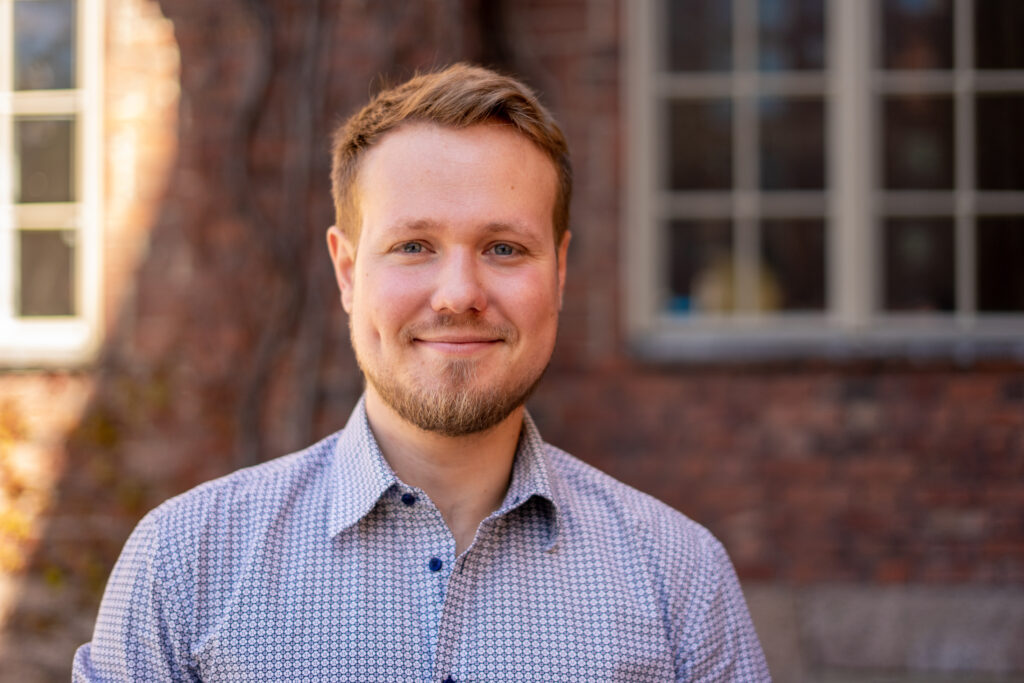
What inspired you to pursue this research topic, and how has your understanding of it evolved throughout your PhD journey?
I have always been fascinated by biological materials such as cellulose. Despite its relatively simple chemical composition, cellulose can form complex structures across many length scales and can be used to create materials with quite different properties. This combination of simplicity and versatility first drew me to the field. The opportunity to combine research on cellulosic materials with neutron scattering allowed me to build on my previous experience with x-ray scattering while exploring new ways of investigating both material structure and dynamics.
At the start of my PhD, I had only limited knowledge of cellulose-based materials. As the project progressed, I came to understand just how complex the interactions between cellulose and water really are. My research therefore developed from a general interest in sustainable materials into a more specific question: how do cellulose nanofibres and water interact, and how do these interactions affect water transport? One of the main lessons from my PhD was that gaining knowledge does not necessarily make a topic feel simpler. Instead, the more deeply you explore it, the more clearly you see how much remains unknown.
Can you describe a key finding or insight from your research that you’re especially proud of – and why it matters in your field?
My research focused on water-based dispersions containing only very small amounts of cellulose nanofibres, with the central question being whether such low concentrations can affect water mobility at all. As it turns out, even at the lowest measured concentrations of 0.2 wt%, the nanofibres reduced water diffusivity much more strongly than expected. The observed reduction was several times larger than that estimated by treating the nanofibres as static rods suspended in water, suggesting that their own motion also plays an important role. Because cellulose nanofibres are semiflexible and constantly bend and fluctuate in the dispersion, they affect the surrounding water not only by taking up physical space, but also through their dynamic movements that result in what we refer to as a dynamic excluded volume.
Although this work was mainly fundamental, it has relevance for applications in which transport needs to be carefully controlled. In filtration systems and biomedical materials, for example, the movement of water, dissolved molecules, or drugs can directly influence a material’s performance. A better understanding of these interactions may therefore support the future design of cellulose-based materials with more precisely tailored transport properties.
How do you hope your research will be used or built upon after your defence – whether in academia, industry, or society at large?
I hope the fundamental insights from my PhD will help in building a clearer picture of how cellulose and water interact, and how these interactions influence the transport properties of cellulose-based materials. A better understanding of this relationship could be useful when developing new functional materials from renewable resources, where water uptake and mobility often influence both processing and final performance of the material.
I also hope that self-diffusion nuclear magnetic resonance (NMR) measurements will become more widely used in cellulose research to complement structural and mechanical characterisation by adding information on transport properties inside the material. Linking these measurements may help researchers better understand the relationship between water dynamics, network structure and material properties.
In the longer term, this work could serve as a starting point for others – whether in academia or industry – to explore how water transport can be controlled in cellulose-based systems. This could support the design of materials for areas such as filtration, packaging, and biomedical applications, and contribute to a broader shift towards renewable, fossil-free material solutions.
What role has SwedNess played in your journey?
SwedNess has played an important role throughout my PhD by introducing me to the world of neutron scattering and showing me how these methods can be used to answer scientific questions that are otherwise difficult to address. This was particularly valuable for my cellulose-based systems, where I wanted to study both material structure and dynamics across different length scales.
Through its courses, SwedNess gave me a good theoretical foundation in neutron scattering and the confidence to apply these methods in my own research. As part of my curriculum, SwedNess also enabled me to spend three months at the Australian Nuclear Science and Technology Organisation (ANSTO), where I gained hands-on experience with small-angle neutron scattering (SANS) and quasielastic neutron scattering (QENS). That stay was particularly important because it complemented my theoretical knowledge with real experiments, data analysis and discussions with instrument scientists.
In addition, SwedNess introduced me to a community of researchers across Sweden working with neutron scattering techniques. This network, shared experiences and friendships that grew from it have been among the most rewarding parts of my PhD journey!
5. What’s next for you? Where is your journey taking you after the defence?
Since defending my PhD in June and taking some time to recharge over the summer, I have begun looking for my next position. I would like to continue working with neutron scattering while applying it to questions closer to real materials and processes. Much of my PhD focused on fundamental questions and small, carefully controlled samples – sometimes only milligrams of material. I now hope to complement that experience with work at a larger and more application-oriented scale.
I am particularly interested in roles that combine scattering methods with sustainable materials research and connect fundamental understanding with practical challenges, whether developing renewable materials, improving industrial processes, or using neutron scattering techniques to better understand complex materials.
My PhD has shown me how powerful scattering techniques can be for linking structure and dynamics and I hope to keep building on this expertise while contributing to work that supports a more sustainable future!