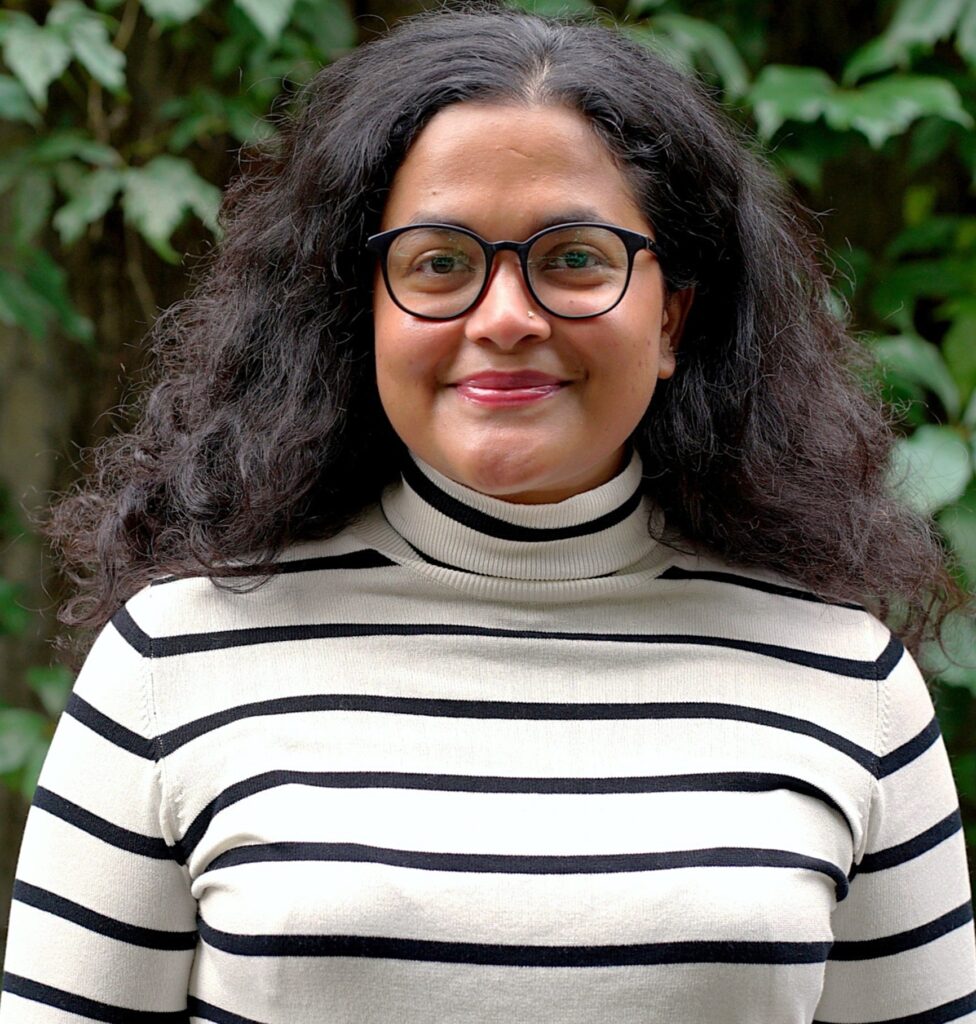
For Priyanka Saha, a postdoctoral researcher at Chalmers University of Technology, the RAC International Summer School offered much more than an introduction to advanced research techniques. It provided new scientific perspectives, valuable professional connections, and important insights into leadership and sustainability that will shape her future career.
With an academic background in physics, Priyanka completed her bachelor’s, master’s, and PhD studies in the field before moving into materials science research. She earned her PhD from the S. N. Bose National Centre for Basic Sciences in India in 2023, where she focused on developing sustainable soft magnetic nanomaterials as alternatives to conventional metallic magnetic materials. Following her doctoral studies, she joined Uppsala University as a postdoctoral researcher, working on additive manufacturing of iron-based soft magnetic bulk metallic glasses for next-generation green motors. She currently conducts research at Chalmers University of Technology, where she develops sustainable and impurity-tolerant aluminium alloys for additive manufacturing using recycled materials.
Priyanka first learned about the RAC International Summer School through an announcement circulated within her division. The opportunity immediately caught her attention because advanced synchrotron X-ray and neutron-based analysis techniques are highly relevant to additive manufacturing research. She hoped to gain a deeper understanding of these large-scale research facilities and learn how they could be applied to her own scientific challenges.
The summer school exceeded her expectations. Alongside learning about neutron imaging, diffraction methods and advanced characterization techniques, she particularly appreciated the practical insights into preparing beamtime proposals, designing experiments and making the most of large-scale research infrastructures.
Several lectures left a lasting impression. One highlight was Prof. Thomas Hase’s lecture on error analysis in experiments, while the workshop led by Anders Sahlman provided useful tools for effectively communicating research. Priyanka also found Prof. Martin Månsson’s session, “The Career Odyssey,” especially valuable as it addressed the often-challenging transition from PhD student to postdoctoral researcher.
Beyond the scientific program, Priyanka emphasized the importance of interacting with fellow participants from diverse disciplines and countries. Poster sessions sparked engaging discussions and knowledge exchange, while the cultural evening provided a memorable opportunity to learn about different backgrounds through food and conversation.
The summer school also broadened her understanding of sustainability. While materials scientists often focus on technological solutions such as batteries, critical raw materials and energy-efficient technologies, Priyanka was inspired by speakers who approached sustainability from wider societal perspectives. In particular, a presentation by Prof. Julia Steinberger challenged her to think about sustainability not only as a research objective but also as a principle that should influence everyday choices and behaviors.
Looking back, Priyanka describes the RAC Summer School as an experience that expanded her view of both science and her role as a researcher. It helped her build connections with experts from complementary research fields and inspired her to explore future opportunities at large-scale X-ray and neutron facilities. She hopes that, in five years, she will have established herself as an independent researcher working at the intersection of materials physics, additive manufacturing and sustainability.
Perhaps the biggest takeaway, however, was the broader perspective she gained on conducting research responsibly and thoughtfully. The exposure to different scientific disciplines, sustainability perspectives and career paths encouraged her to remain curious beyond her immediate research area. And as the cherry on top, the leadership education offered during the summer school proved especially valuable. The sessions on the human side of science and academic leadership provided important lessons for early-career researchers aspiring to take on future leadership roles, making the experience impactful not only academically but also personally.
If she were to summarize the RAC Summer School in just three words, Priyanka’s choice would be simple: Sustainability. Leadership. Perspective.
As she reflects on the experience, one quote continues to resonate:
“Knowledge is not free. You have to pay attention.” – Richard P. Feynman
For Priyanka, it serves as a reminder that learning begins with curiosity, attention and an openness to see beyond one’s own field of expertise.