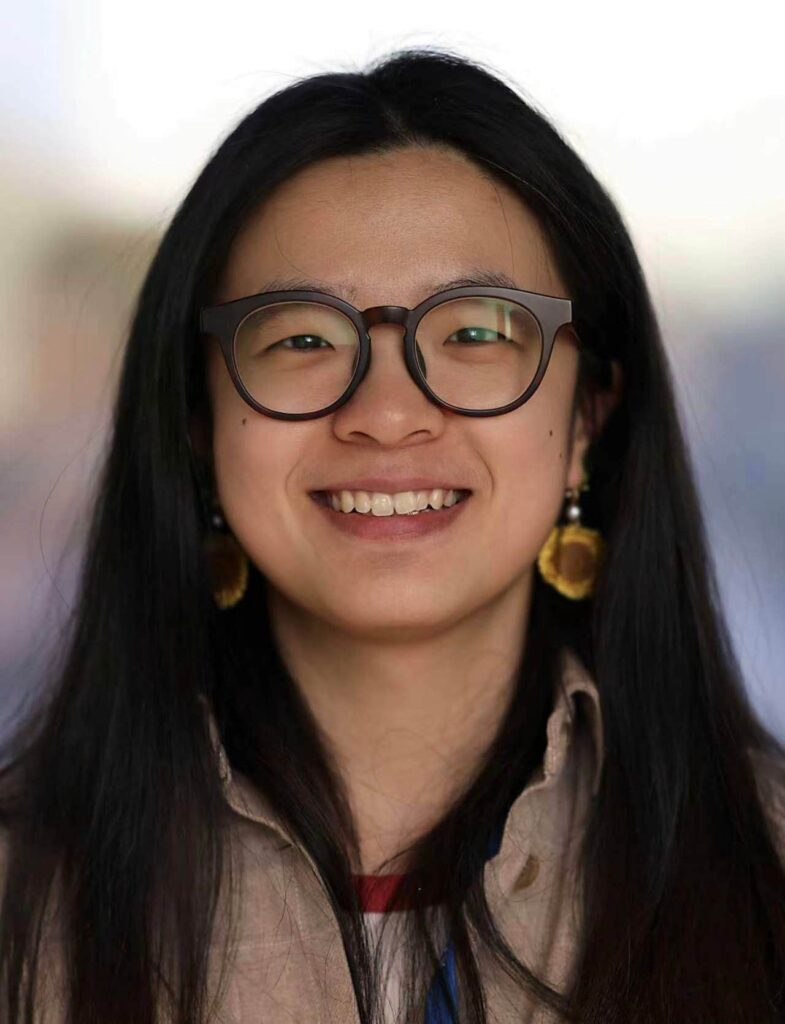
What inspired you to pursue this research topic, and how has your understanding of it evolved throughout your PhD journey?
I have been interested in low-dimensional materials. On the other hand, neutron scattering and MuSR as new techniques to me are also fascinating.
One of the most interesting understandings I had during my PhD is that a large part of quantum material studies and subsequently a large fraction of the characterisation techniques for quantum materials involve the concept of correlations. We measure the correlations between atoms in crystal and between spins in magnetism, as well as correlations in the time domain. For order in space, it can be long or short range, while for those in the time domain, dynamics can be dispersive or random fluctuations. The usage of characterisation techniques should be combined if needed and different techniques often complementary to each other even beyond techniques with neutron.
Can you describe a key finding or insight from your research that you’re especially proud of – and why it matters in your field?
I studied some previously unrevealed phase transitions of some quasi-2-dimensional material in external stimulis such as temperature, pressure, and magnetic field. Some of them like CrCl3 itself can also be prepared in monolayer limit from people’s report. It has been predicted to work as a flexible test bed to be tuned between the Ising and XY-model, and some correlations in it can be tuned between ferromagnetic and antiferromagnetic by strain. With hydrostatic pressure we have confirmed the tunability of one of the interactions. Although our experiment was realized in the bulk instead of monolayer, but it may motivate a real monolayer experiment to change the magnetism in CrCl3 by strain.
How do you hope your research will be used or built upon after your defense – whether in academia, industry, or society at large?
I hope my research may provide some information that could be potentially useful in understanding the phases, correlations, and interactions in these quantum materials for future study.
What role has SwedNess played in your journey?
SwedNess has played a key role in my PhD. First of all, the SwedNess led me to the world of neutron scattering in quantum materials. Here I met people in different field but all using neutron scattering. I had the chance to know all the excellent people themselves supporting each other with their background. It is also an extremely broad knowledge when people like this are gathered. With all these varied aspects of the usage of neutron, my understanding of neutron becomes not only limited in the simple “diffraction” regime of crystals but also all ranges of time / energy and space resolutions available.
What’s next for you? Where is your journey taking you after the defense?
I am planning on continuing science in academia.